Bates’ Guide, often accessed as a PDF, remains a cornerstone resource for medical professionals, detailing comprehensive techniques for patient assessment and clinical documentation.
Historical Context of the Guide
Bates’ Guide to Physical Examination and History Taking initially emerged as a practical manual designed to standardize the teaching of clinical skills. Its origins trace back to the mid-20th century, a period witnessing significant advancements in medical understanding and a growing emphasis on the physician-patient relationship. The guide’s early editions, often distributed as a PDF for accessibility, focused on a systematic approach to gathering patient information and performing physical assessments.
Over decades, the guide evolved through numerous revisions, incorporating new research, diagnostic techniques, and evolving medical best practices. The digital format, including readily available PDF versions, broadened its reach, making it a ubiquitous resource in medical schools and clinical settings globally. The enduring legacy of Bates’ Guide lies in its commitment to a patient-centered approach, emphasizing thoroughness and meticulous observation—qualities essential for effective medical practice.
Significance in Medical Education
Bates’ Guide to Physical Examination and History Taking holds paramount significance in medical education, serving as a foundational text for generations of physicians. Its structured approach to patient assessment, readily available in PDF format, provides a standardized framework for learning essential clinical skills. Medical students rely on the guide to master techniques like auscultation, palpation, and neurological examination, building a strong base for diagnostic reasoning.
The guide’s emphasis on detailed history taking and comprehensive physical exams cultivates a patient-centered approach, crucial for developing effective doctor-patient communication. The accessibility of the PDF version facilitates convenient study and quick reference during clinical rotations. Furthermore, Bates’ Guide promotes critical thinking and analytical skills, preparing future doctors to confidently navigate complex medical scenarios and deliver optimal patient care.

Core Components of History Taking
Bates’ Guide, often found as a convenient PDF, emphasizes a systematic approach to history taking: chief complaint, present illness, past medical, family, and social history.
Chief Complaint – Eliciting the Primary Concern
Bates’ Guide to Physical Examination and History Taking, readily available as a PDF resource, stresses the importance of directly ascertaining the patient’s chief complaint. This initial step, often documented in the patient’s own words, establishes the primary reason for seeking medical attention. The guide advocates for open-ended questioning – allowing the patient to freely describe their concerns – before refining the statement into a concise and focused problem.
Effective elicitation requires active listening and avoiding leading questions. The clinician should encourage the patient to elaborate, clarifying any ambiguities without imposing their own assumptions. A well-defined chief complaint serves as a crucial foundation for the subsequent, more detailed exploration of the patient’s history, guiding the focused physical examination and ultimately, accurate diagnosis and treatment planning. The PDF version of Bates’ Guide provides illustrative examples of effective questioning techniques.
History of Present Illness – Detailed Chronological Account
As detailed within the Bates’ Guide to Physical Examination and History Taking – often consulted in its convenient PDF format – the History of Present Illness (HPI) demands a systematic, chronological narrative of the patient’s current ailment. This section expands upon the chief complaint, meticulously documenting the onset, location, duration, character, alleviating/aggravating factors, radiation, timing, and severity (OLDCARTS) of the symptoms.
The guide emphasizes the importance of patient narration, supplemented by targeted questioning to fill any gaps. Clinicians are encouraged to avoid premature closure and to explore all relevant aspects of the illness. A thorough HPI, as exemplified in the PDF, provides a critical context for understanding the patient’s condition and differentiating between potential diagnoses, ultimately informing the subsequent physical examination and treatment plan.
Past Medical History – Previous Illnesses and Surgeries
The Bates’ Guide to Physical Examination and History Taking, readily available as a PDF resource, underscores the significance of a comprehensive Past Medical History (PMH). This section meticulously documents all previous illnesses, hospitalizations, surgeries, and significant injuries experienced by the patient. Details regarding dates, diagnoses, and treatments are crucial for identifying potential contributing factors to the current complaint.
The guide advises clinicians to inquire about childhood illnesses, chronic medical conditions (like diabetes or hypertension), and any prior psychiatric diagnoses. A complete surgical history should include the type of procedure, date, and any associated complications. Furthermore, documenting allergies (medications, food, environmental) is paramount; A well-constructed PMH, as demonstrated within the PDF, provides invaluable context for interpreting current findings and formulating a differential diagnosis.
Family History – Genetic Predispositions and Patterns
As detailed in the Bates’ Guide to Physical Examination and History Taking – often consulted as a PDF – a thorough Family History is essential for assessing genetic predispositions to disease. This involves gathering information about the health status of immediate family members (parents, siblings, children) and, when possible, extended relatives (grandparents, aunts, uncles).
The guide emphasizes inquiring about specific conditions known to have a genetic component, such as heart disease, cancer, diabetes, and mental health disorders. Documenting the age of onset for these conditions within the family can reveal inheritance patterns. It’s crucial to ascertain ethnicity, as certain genetic conditions are more prevalent in specific populations. A detailed family history, readily facilitated by the PDF’s structured approach, aids in risk assessment and informs preventative strategies.
Social History – Lifestyle Factors and Environmental Influences
The Bates’ Guide to Physical Examination and History Taking, frequently utilized in its PDF format, underscores the importance of a comprehensive Social History. This section explores lifestyle factors impacting a patient’s health, extending beyond medical diagnoses. Key areas include tobacco use (type, quantity, duration), alcohol consumption (frequency, amount), and illicit drug use.
Furthermore, the guide stresses documenting occupational history, including potential exposures to hazards. Inquiring about diet, exercise habits, and sleep patterns provides insight into overall wellness. Social support systems, living situation, and cultural factors are also vital. Understanding these environmental and behavioral influences, as outlined in the PDF, allows clinicians to tailor treatment plans and address modifiable risk factors for improved patient outcomes.

Techniques in Physical Examination
Bates’ Guide, available as a PDF, systematically details examination techniques – inspection, palpation, percussion, and auscultation – for a thorough patient assessment.
General Appearance and Vital Signs
Bates’ Guide to Physical Examination and History Taking, frequently utilized in its PDF format, emphasizes that assessing a patient begins with observing their general appearance. This includes noting their level of consciousness, nutritional status, and any obvious signs of distress or discomfort.
Crucially, the guide details the proper techniques for measuring vital signs – temperature, pulse, respiration rate, and blood pressure. Accurate measurement and interpretation of these parameters are fundamental to establishing a baseline and identifying potential abnormalities. The PDF version often includes detailed illustrations and step-by-step instructions for each procedure, ensuring consistent and reliable data collection.
Furthermore, Bates’ Guide stresses the importance of considering the context of these findings; vital signs should always be interpreted in relation to the patient’s age, sex, and overall clinical presentation. This holistic approach, readily accessible within the PDF resource, is central to effective patient care.
Skin Examination – Assessing for Rashes and Lesions
Bates’ Guide to Physical Examination and History Taking, conveniently available as a PDF, dedicates significant attention to dermatological assessment. A systematic skin examination, as outlined in the guide, involves inspection for color, temperature, moisture, and the presence of any lesions. The PDF resource provides detailed descriptions and visual aids to assist in identifying various types of rashes and lesions.
Key characteristics to note include the lesion’s morphology (macule, papule, vesicle, etc.), distribution, and arrangement. Bates’ Guide emphasizes the importance of using appropriate terminology to accurately document these findings. The PDF format allows for easy referencing of these descriptive terms during the examination.
Furthermore, the guide highlights the need to consider the patient’s history and potential exposures when evaluating skin abnormalities, aiding in differential diagnosis. This comprehensive approach, readily accessible within the PDF, is crucial for effective dermatological assessment.
Head, Eyes, Ears, Nose, and Throat (HEENT) Examination
Bates’ Guide to Physical Examination and History Taking, in its accessible PDF format, provides a structured approach to the HEENT examination. This section details techniques for assessing each component, beginning with skull palpation and assessing for tenderness or masses. The PDF emphasizes proper lighting and positioning for optimal visualization.
Eye examination, as detailed in the guide, includes visual acuity testing, pupillary response assessment, and fundoscopic examination. The PDF offers clear instructions and diagrams for performing these techniques. Ear examination involves otoscopy to evaluate the tympanic membrane and ear canal.
Nose and throat assessment focuses on identifying any abnormalities in the nasal mucosa, sinuses, and oral cavity. Bates’ Guide’s PDF stresses the importance of systematic evaluation and accurate documentation of findings, ensuring a thorough HEENT examination.
Cardiovascular Examination – Heart Sounds and Murmurs
Bates’ Guide to Physical Examination and History Taking, readily available as a PDF, dedicates significant attention to cardiovascular assessment. The guide meticulously outlines the steps for auscultating heart sounds – S1 and S2 – emphasizing proper diaphragm and bell placement for optimal sound capture. The PDF details identifying normal versus abnormal splitting of these sounds.
A crucial component, as highlighted in the PDF, is the detection and characterization of heart murmurs. Bates’ Guide provides a systematic approach to describing murmurs based on timing, location, intensity, pitch, and quality.
The PDF also covers assessing for extra heart sounds (S3, S4) and rubs, alongside techniques for evaluating peripheral pulses and identifying signs of cardiovascular disease. Accurate documentation, guided by the PDF, is paramount for effective clinical decision-making.
Respiratory Examination – Lung Sounds and Breathing Patterns
Bates’ Guide to Physical Examination and History Taking, conveniently accessible as a PDF, provides a detailed framework for evaluating respiratory function. The PDF emphasizes the importance of inspecting breathing patterns – noting rate, rhythm, and depth – before proceeding to auscultation. Systematic auscultation, comparing sounds bilaterally, is a core skill detailed within the guide.
The PDF meticulously describes normal breath sounds (vesicular, bronchial, bronchovesicular) and abnormal sounds like crackles (rales), wheezes, rhonchi, and stridor. Bates’ Guide offers guidance on differentiating these sounds based on their timing and characteristics.
Furthermore, the PDF covers techniques for assessing chest expansion and percussion, aiding in the identification of consolidation or pleural effusion. Accurate documentation, as illustrated in the PDF, is essential for diagnosing and managing respiratory conditions.
Abdominal Examination – Palpation and Auscultation
Bates’ Guide to Physical Examination and History Taking, readily available as a PDF, outlines a systematic approach to abdominal assessment. The PDF stresses beginning with auscultation to assess bowel sounds before proceeding to palpation, as palpation can alter bowel activity. It details differentiating normal, active, hypoactive, and hyperactive bowel sounds.
The PDF then guides clinicians through various palpation techniques – light and deep – to identify tenderness, masses, and organomegaly. Bates’ Guide emphasizes the importance of using both hands for palpation and assessing for rebound tenderness and guarding.
Percussion is also covered in the PDF, helping to determine organ size and detect fluid or gas. Accurate documentation of findings, as exemplified in the PDF, is crucial for diagnosing abdominal pathologies.
Neurological Examination – Reflexes, Sensation, and Motor Function
Bates’ Guide to Physical Examination and History Taking, often consulted as a PDF resource, provides detailed instructions for a comprehensive neurological assessment. The PDF emphasizes evaluating mental status, cranial nerves, motor function, sensation, and reflexes in a systematic order.
Regarding reflexes, the PDF details how to elicit deep tendon reflexes (DTRs) and grade them on a scale of 0 to 4+. It also covers pathological reflexes like the Babinski sign. Sensory testing, as described in the PDF, includes assessing light touch, pain, temperature, and vibration.
Motor function evaluation, outlined in the PDF, involves observing gait, posture, and muscle strength, often graded on a 0-5 scale. The PDF stresses the importance of comparing findings bilaterally and documenting any deficits accurately.
Musculoskeletal Examination – Range of Motion and Joint Stability
Bates’ Guide to Physical Examination and History Taking, frequently utilized as a PDF, meticulously details the musculoskeletal assessment process. The PDF emphasizes a systematic approach, beginning with inspection for asymmetry, swelling, or deformity. Palpation assesses tenderness, crepitus, and muscle bulk, as detailed within the PDF.
Range of motion (ROM) testing, thoroughly explained in the PDF, involves assessing active and passive movements, noting any limitations or pain. The PDF instructs examiners to document ROM in degrees. Joint stability is evaluated through specific maneuvers designed to stress ligaments and tendons, as illustrated in the PDF.
Special tests, outlined in the PDF, help identify specific musculoskeletal conditions. Accurate documentation of findings, guided by the PDF, is crucial for diagnosis and treatment planning.

Specific Examination Techniques
Bates’ Guide, often found as a convenient PDF, provides detailed protocols for focused assessments, including lymph node palpation and specialized clinical evaluations.
Lymph Node Palpation – Detecting Enlargement and Tenderness
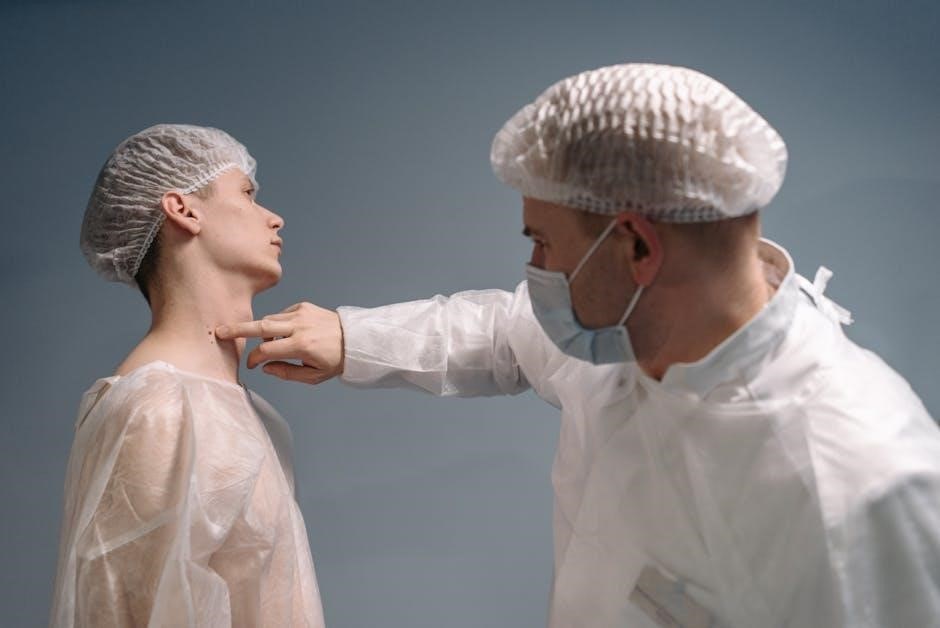
Bates’ Guide to Physical Examination and History Taking, readily available as a PDF, emphasizes a systematic approach to lymph node palpation. This crucial technique involves utilizing gentle, circular motions with the pads of the fingers to assess for enlargement, tenderness, and consistency. The guide details palpation of key areas – cervical, supraclavicular, axillary, epitrochlear, and inguinal regions – noting normal versus abnormal findings.
Proper technique, as illustrated within the PDF version, includes comparing both sides of the body simultaneously. Documenting the size, shape, mobility, and any associated pain is paramount. The Bates’ Guide stresses differentiating between localized versus generalized lymphadenopathy, aiding in differential diagnosis. Recognizing characteristics suggestive of inflammatory, infectious, or neoplastic processes is a key skill honed through studying this resource.
Furthermore, the PDF highlights the importance of considering patient history and other physical exam findings when interpreting lymph node assessment results, ensuring a holistic clinical evaluation.
Breast Examination – Self-Examination and Clinical Assessment

Bates’ Guide to Physical Examination and History Taking, accessible as a comprehensive PDF, dedicates significant attention to breast examination techniques. It outlines both the importance of patient education regarding breast self-examination (BSE) and the methodology for thorough clinical breast assessment. The PDF details a systematic four-quadrant palpation approach, utilizing different finger pads and pressures to detect subtle masses or changes.
The guide emphasizes inspecting for skin changes – dimpling, redness, or edema – and nipple abnormalities, such as inversion or discharge. Bates’ clearly explains how to properly palpate for axillary lymph nodes, crucial for assessing potential metastasis. The PDF stresses documenting the location, size, shape, consistency, and mobility of any palpable masses;
Furthermore, the resource highlights the significance of considering patient risk factors and family history when interpreting findings, guiding appropriate follow-up and referral decisions, ensuring comprehensive care.
Genitourinary Examination – Assessing for Abnormalities
Bates’ Guide to Physical Examination and History Taking, readily available as a detailed PDF resource, provides a structured approach to genitourinary assessment. The PDF emphasizes patient privacy and sensitivity during this examination. It details inspection of the external genitalia for lesions, inflammation, or discharge, noting any abnormalities in skin color or contour.
Palpation of the kidneys, utilizing techniques like bimanual palpation, is thoroughly explained within the PDF, alongside assessment for costovertebral angle tenderness. Bates’ guides clinicians through evaluating for hernias and scrotal masses, differentiating between transillumination and non-transilluminating lesions.
The guide stresses the importance of documenting findings accurately, including size, location, and characteristics of any abnormalities. It also highlights the need for appropriate referral based on examination results, ensuring comprehensive patient care and follow-up.

Utilizing Bates’ Guide in Clinical Practice
Bates’ Guide, often consulted as a convenient PDF, empowers clinicians to synthesize history and physical findings for accurate diagnoses and effective treatment plans.
Integrating History and Physical Findings
Bates’ Guide to Physical Examination and History Taking, frequently utilized in its accessible PDF format, emphasizes the crucial interplay between subjective patient narratives and objective clinical observations. Effectively merging the detailed history – encompassing chief complaints, present illness, past medical, family, and social factors – with the systematic findings from the physical exam is paramount.
The guide instructs clinicians to analyze how physical signs corroborate or contradict reported symptoms, prompting further investigation when discrepancies arise. This integrated approach facilitates differential diagnosis, guiding practitioners toward the most probable etiology. A thorough understanding, as detailed within the PDF version, allows for a holistic patient assessment, moving beyond isolated data points to a cohesive clinical picture.
Ultimately, skillful integration, supported by Bates’ Guide, enhances diagnostic accuracy and informs personalized treatment strategies, improving patient outcomes.
Documentation and Reporting
Bates’ Guide to Physical Examination and History Taking, readily available as a PDF resource, underscores the significance of meticulous documentation as a cornerstone of quality patient care and legal defensibility. The guide advocates for a structured, organized approach to recording findings, mirroring the systematic nature of the examination itself.
Clear, concise, and objective language is emphasized, avoiding subjective interpretations or assumptions. Detailed notes on both positive and negative findings are crucial, alongside a comprehensive summary of the patient’s history. The PDF version often highlights the importance of utilizing standardized medical terminology to ensure clarity and avoid ambiguity.
Proper documentation, guided by Bates’ principles, facilitates effective communication among healthcare professionals, supports accurate billing, and provides a valuable record for future reference and potential legal scrutiny.
Common Pitfalls and How to Avoid Them
Bates’ Guide to Physical Examination and History Taking, even in its accessible PDF format, acknowledges inherent challenges in clinical assessment. A frequent pitfall is premature closure – forming a diagnosis too early, hindering thorough investigation. The guide stresses maintaining objectivity and resisting the urge to confirm initial impressions without complete data.
Another common error is inadequate history taking; failing to elicit crucial details about the patient’s present illness or past medical background. Bates’ methodology emphasizes open-ended questioning and active listening.
Insufficient physical examination, overlooking key findings due to time constraints or lack of focus, is also addressed. The PDF resource reinforces systematic examination, ensuring all relevant systems are assessed. Finally, poor documentation, lacking clarity or detail, can compromise patient care and legal protection.

Bates’ Guide and Digital Resources
Bates’ Guide is readily available as a PDF, alongside online supplements and mobile applications, enhancing accessibility and providing updated clinical information.
PDF Accessibility and Features
The Bates’ Guide to Physical Examination and History Taking in PDF format offers numerous advantages for students and practitioners. Many PDF readers highlight “Bates coding” as a key feature, particularly valuable for legal professionals needing secure document management. This digital version allows for searchable text, enabling quick access to specific examination techniques or historical data.
Furthermore, the PDF format facilitates portability, allowing users to access the guide on various devices – laptops, tablets, and smartphones. Interactive features, such as embedded videos demonstrating examination procedures, are sometimes included in enhanced PDF versions. Accessibility options, like text-to-speech functionality, cater to diverse learning needs. The PDF’s structure mirrors the print edition, maintaining the guide’s logical organization and ease of navigation. Regular updates and supplements are often distributed as PDF addendums, ensuring the content remains current with evolving medical practices.
Online Supplements and Updates
Complementing the core Bates’ Guide to Physical Examination and History Taking PDF, a wealth of online supplements continually enhance its value. Publishers frequently release updated chapters addressing emerging medical knowledge and refined examination techniques. These digital additions often include video demonstrations of complex procedures, providing a visual learning aid beyond static images.
Interactive case studies and self-assessment quizzes are commonly available online, reinforcing comprehension and clinical application. Access to these resources typically requires registration or purchase of the guide. Online forums and communities allow users to discuss challenging cases and share best practices. The digital platform enables rapid dissemination of critical updates, such as new guidelines for infection control or revised diagnostic criteria, ensuring practitioners have access to the most current information. These supplements extend the lifespan and utility of the foundational PDF resource.
Mobile Applications and Companion Tools
Recognizing the demands of modern clinical practice, several mobile applications serve as convenient companions to the comprehensive Bates’ Guide to Physical Examination and History Taking PDF. These apps often distill key information from the guide into a readily accessible format for point-of-care reference. Features commonly include searchable databases of physical findings, illustrative images, and concise procedural guides.
Some applications offer interactive tools, such as heart and lung sound libraries, allowing users to hone their auscultation skills. Offline access is a crucial benefit, ensuring usability even without an internet connection. Companion tools may also integrate with electronic health record (EHR) systems, streamlining documentation. While these apps are valuable aids, they should not replace a thorough understanding of the principles outlined in the complete PDF guide, serving instead as practical extensions for busy clinicians.

Bates’ Guide and Legal Considerations
Bates’ Guide, including its PDF version, emphasizes meticulous medical record keeping and adherence to patient confidentiality protocols for legal protection.
Medical Record Keeping and Bates Stamping
Bates’ Guide to Physical Examination and History Taking underscores the critical importance of thorough and accurate medical record keeping, a cornerstone of both quality patient care and legal defensibility. Proper documentation, as facilitated by resources like the PDF version of the guide, ensures a clear chronological account of patient encounters.
Bates stamping, a process of sequentially numbering each page of a medical record, is highlighted as a vital practice. This method provides a secure and verifiable audit trail, preventing alteration or loss of information. The guide details how consistent application of Bates numbers aids in organization, retrieval, and presentation of records during legal proceedings or audits.
Furthermore, the guide stresses the necessity of dating and signing all entries, clearly identifying the author, and utilizing objective language. Maintaining a complete and organized record, utilizing techniques like Bates stamping, directly correlates with minimizing legal risks and upholding professional standards, as outlined within the Bates’ Guide itself.
Confidentiality and Patient Privacy
Bates’ Guide to Physical Examination and History Taking consistently emphasizes the paramount importance of maintaining strict patient confidentiality throughout the entire clinical process. Accessing the guide, even in PDF format, reinforces the ethical and legal obligations surrounding protected health information (PHI).
The guide details the necessity of obtaining informed consent before any examination or history taking, clearly explaining the purpose and scope of the assessment. It stresses the importance of discussing information only with authorized personnel involved in the patient’s care, adhering to HIPAA regulations and institutional policies.
Furthermore, Bates’ Guide highlights secure storage and handling of medical records, whether physical or digital. Proper documentation, as detailed within the guide, should avoid unnecessary disclosure of sensitive information. Upholding patient privacy is not merely a legal requirement, but a fundamental aspect of building trust and delivering ethical healthcare, as consistently advocated by the guide.