Psalm 119 in Hebrew: A Comprehensive Guide
Discover a detailed exploration of Psalm 119 in its original Hebrew form. This guide offers resources for studying the text,
including downloadable PDF versions and tools for translation and deeper understanding.
Psalm 119 stands as a monumental work within the Book of Psalms, uniquely celebrated for its extraordinary length and profound focus on the Law of God – the Torah. It’s not merely a psalm; it’s a literary masterpiece, a devotional hymn, and a testament to the enduring power of God’s word. Its extensive nature, comprising 176 verses, makes it the longest chapter in the Bible, and its thematic consistency is remarkable.
This psalm isn’t intended for a quick read; it’s designed for meditative engagement. Many seek resources like a Psalm 119 in Hebrew PDF to facilitate in-depth study, allowing for careful examination of the original text alongside translations and commentaries. The psalm’s structure, an acrostic poem based on the Hebrew alphabet, adds another layer of complexity and beauty, inviting readers to contemplate each letter and its associated verses.
Understanding Psalm 119 requires appreciating its historical and cultural context within Jewish tradition, where the Torah holds central importance. It’s a psalm that speaks to the heart of faith, offering guidance, comfort, and a pathway to a deeper relationship with the Divine.
The Significance of Psalm 119 in Jewish Tradition
Psalm 119 holds a particularly esteemed position within Jewish tradition, deeply interwoven with the reverence for the Torah – God’s Law. It’s considered a cornerstone of Jewish liturgical practice and a frequent subject of study and contemplation. For centuries, Jewish scholars and individuals have turned to this psalm for guidance, inspiration, and a profound connection to their faith.
The psalm’s emphasis on the enduring nature and perfection of God’s word resonates strongly with the Jewish belief in the eternal validity of the Torah. Accessing resources like a Psalm 119 in Hebrew PDF allows for a closer examination of the original text, revealing nuances often lost in translation. This deeper engagement fosters a richer understanding of its spiritual significance.
Traditionally, reciting or studying Psalm 119 is believed to bring blessings and protection. It’s often incorporated into daily prayers and observed during times of hardship, offering solace and reaffirming faith in God’s unwavering commitment to His people.
Overview of the Hebrew Text
Psalm 119, in its original Hebrew form, is a remarkably lengthy and intricate composition. The Massoretic Text (MT) serves as the authoritative Hebrew version, meticulously preserved over centuries. Studying the Hebrew text reveals a poetic structure and depth of meaning often obscured in translations. The psalm consists of 176 verses, making it the longest chapter in the Book of Psalms.
A valuable resource for exploration is a Psalm 119 in Hebrew PDF, enabling detailed textual analysis. The Hebrew utilizes a rich vocabulary and employs various poetic devices, including parallelism and imagery, to convey its message. Understanding the grammatical nuances and word choices enhances appreciation for the psalm’s artistry.
The text is characterized by its consistent focus on God’s law, utilizing terms like Torah, edut (testimony), and pikudim (commandments) to describe divine instruction. Careful examination of these terms within their context provides insight into the Jewish understanding of God’s relationship with humanity.
The Acrostic Structure of Psalm 119
Psalm 119 is uniquely structured as an acrostic poem, a literary form where successive sections begin with consecutive letters of the Hebrew alphabet. Each of the 22 letters receives its own eight-verse stanza, creating a deliberate and memorable framework. This structure isn’t merely ornamental; it serves to emphasize the completeness and perfection of God’s law, encompassing all aspects of life.
A Psalm 119 in Hebrew PDF allows for a visual tracing of this pattern, highlighting how each section is dedicated to a specific Hebrew letter. The letters appear in their traditional order: Aleph, Beth, Gimel, and so on. This arrangement likely aided memorization and provided a meditative focus for readers.
The consistent eight-verse format within each section reinforces the thematic unity while allowing for nuanced exploration of different facets of God’s word. This deliberate organization underscores the psalm’s central message: the enduring and all-encompassing nature of divine revelation.
Each Section Dedicated to a Hebrew Letter

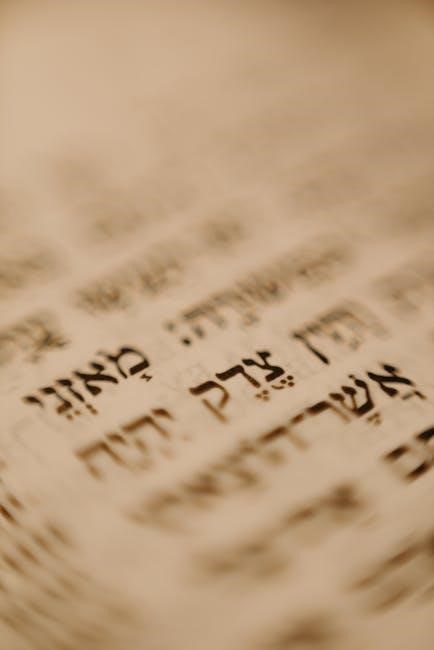
Psalm 119 distinguishes itself through its remarkable organization, dedicating each of its 22 sections to a successive letter of the Hebrew alphabet. This means the first eight verses all begin with the letter Aleph (א), the next eight with Beth (ב), and so forth, continuing through the entire Hebrew alphabet. A Psalm 119 in Hebrew PDF visually demonstrates this pattern, making the structure immediately apparent.
This isn’t simply a poetic device; it’s a powerful literary technique that emphasizes the comprehensive nature of God’s law. Each letter represents a facet of His word, and the eight verses within each section explore that facet in detail. The consistent structure aids memorization and provides a framework for meditative study.
Studying the psalm with a Hebrew text and a corresponding PDF reveals how the initial letter subtly influences the themes and vocabulary within each section, creating a cohesive and meaningful whole.
The Eight Verses Per Letter Section
Psalm 119 is uniquely structured with 22 sections, each comprising eight verses. This consistent pattern, tied to the Hebrew alphabet, isn’t arbitrary. Each grouping of eight verses explores a specific aspect of God’s law, all while beginning with the designated letter of that section. A Psalm 119 in Hebrew PDF clearly illustrates this repetition and thematic unity.
Within these eight verses, you’ll find a variety of poetic expressions – prayers, praises, and declarations of obedience. The verses often employ parallelism, where similar ideas are expressed in different ways, reinforcing the message. Examining a Hebrew text alongside a PDF translation reveals the nuances of the original language.
This eight-verse structure isn’t just about quantity; it’s about depth. It allows for a thorough exploration of each letter’s associated themes, creating a rich and multifaceted meditation on God’s word.
Hebrew Alphabet and its Relation to the Psalm
Psalm 119’s remarkable structure is intrinsically linked to the Hebrew alphabet. Each of the psalm’s 22 sections corresponds to a letter, progressing sequentially from Aleph (א) to Tav (ת). This acrostic form isn’t merely decorative; it’s a deliberate literary device emphasizing the completeness and perfection of God’s law. A Psalm 119 in Hebrew PDF visually demonstrates this alphabetical arrangement.
The Hebrew letters aren’t simply labels; they carry symbolic weight and numerical values within Jewish tradition. The choice to organize the psalm around them suggests a profound connection between the divine word and the very building blocks of the Hebrew language. Studying a PDF with transliteration aids in recognizing these letter associations.
This structure invites a meditative approach, encouraging readers to contemplate each letter and its corresponding verses, unlocking deeper layers of meaning within the text.
Aleph (א) – The First Section
Aleph (א) initiates Psalm 119, setting the thematic foundation for the entire psalm. The first eight verses (1-8) center on the blessedness of those who walk in God’s law, emphasizing purity of heart and unwavering commitment to His commandments. A Psalm 119 in Hebrew PDF clearly displays these opening verses alongside their transliteration and English translation.
The verses within this section highlight the importance of keeping God’s precepts, seeking Him with all one’s heart, and avoiding straying from His word. The imagery of a lamp and a sweeping path illustrates guidance and moral clarity. Examining a PDF version allows for detailed analysis of the Hebrew vocabulary used to convey these concepts.
This initial section establishes the core principle of Psalm 119: that true happiness and fulfillment are found in obedience to God’s law, a concept richly explored throughout the entire psalm.
Beth (ב) – The Second Section
Beth (ב), the second letter of the Hebrew alphabet, introduces verses 9-16 of Psalm 119. This section continues the theme of purity and righteousness, focusing on how a young person can keep their life undefiled. A readily available Psalm 119 in Hebrew PDF provides a visual and textual aid for studying these verses in their original language.
The verses emphasize hiding God’s word in the heart to avoid sinning against Him. The imagery of a lamp shining upon one’s path reappears, reinforcing the idea of God’s word as a source of guidance and illumination. Studying a PDF version allows for a close examination of the Hebrew words used to describe this internalizing of scripture.
This section underscores the proactive nature of maintaining a righteous life – it’s not merely avoiding sin, but actively seeking God’s word and allowing it to shape one’s thoughts and actions.

Gimel (ג) – The Third Section
Gimel (ג), the third letter in the Hebrew alphabet, governs verses 17-24 of Psalm 119. This section expands on the desire for God’s law, portraying the psalmist as longing for His commandments. Accessing a Psalm 119 in Hebrew PDF is invaluable for appreciating the nuances of this longing expressed in the original text.
The verses highlight the joy and delight found in meditating on God’s statutes and considering His ways. The psalmist pleads for understanding and guidance, recognizing their need for divine instruction. A PDF format facilitates detailed examination of the Hebrew vocabulary used to convey these emotions and requests.
This section also introduces the idea of God’s testimonies being a foundation for wisdom and understanding. The psalmist’s counselors and elders are mentioned, demonstrating a desire to share God’s word with others.
Translation and Transliteration Resources
Studying Psalm 119 in Hebrew requires accessible resources for translation and transliteration. Numerous online tools and downloadable materials, including a Psalm 119 in Hebrew PDF, can aid in this process. The Israel Bible offers a Hebrew-English translation alongside the Massoretic Text, providing a valuable comparative study option.
Interlinear Hebrew Bibles present the Hebrew text with corresponding English translations directly beneath each word, facilitating a deeper understanding of the original language. These resources are often available in PDF format for convenient offline access.
Strong’s Concordance is an essential tool for researching the meanings of individual Hebrew words, offering detailed etymological information. Utilizing these resources, alongside a PDF of the Psalm, empowers students to unlock the rich theological depth embedded within the Hebrew text of Psalm 119.
The Israel Bible and Psalm 119
The Israel Bible presents a unique approach to studying Psalm 119, offering a comprehensive Hebrew-English translation alongside insightful commentary rooted in Jewish tradition. Access to the text, often available as a downloadable Psalm 119 in Hebrew PDF, allows for detailed examination of the original Hebrew and its interpretations.
This resource highlights the connections between the Psalm and broader biblical themes, enriching the reader’s understanding of its significance within Jewish thought. The Israel Bible’s platform, including Bible Plus, provides supplementary materials like biblical themes and insights, enhancing the study experience.
Furthermore, the inclusion of the Massoretic Text alongside the English translation facilitates a direct comparison, aiding in accurate interpretation. Utilizing the Israel Bible, and a corresponding PDF version, provides a robust foundation for exploring the depths of Psalm 119.

Online Interlinear Hebrew Bibles
Numerous online interlinear Hebrew Bibles offer invaluable tools for studying Psalm 119. These resources present the Hebrew text alongside English translations, often word-for-word, facilitating a deeper understanding of the original language. Many platforms allow downloading portions, including a Psalm 119 in Hebrew PDF, for offline study.
These digital tools are particularly helpful when combined with Strong’s Concordance, enabling users to explore the nuances of each Hebrew word. Interlinear Bibles provide a bridge for those unfamiliar with Hebrew, allowing them to trace the meaning of the text and appreciate its poetic structure.

Accessing Psalm 119 through these online resources, and saving it as a PDF, empowers independent study and facilitates a more profound connection with the scripture. They are essential for anyone seeking to delve into the Hebrew roots of this powerful Psalm.
Strong’s Concordance for Hebrew Words
Utilizing Strong’s Concordance is crucial when studying Psalm 119 in Hebrew. This tool provides detailed definitions and etymological information for each Hebrew word, enriching comprehension beyond a simple translation. When examining a Psalm 119 in Hebrew PDF, referencing Strong’s reveals the original meaning and context of key terms.
Strong’s assigns a unique number to each Hebrew word, allowing for consistent cross-referencing across different translations and study tools. This is particularly valuable for understanding the nuances of the Psalm’s vocabulary, such as words related to Torah, obedience, and God’s law.
By combining a Hebrew text – perhaps a downloaded PDF version – with Strong’s Concordance, students can unlock a deeper layer of meaning within Psalm 119, appreciating the author’s intended message and the richness of the Hebrew language.
Key Themes in Psalm 119

Psalm 119, even when studied via a Psalm 119 in Hebrew PDF, consistently highlights several core themes. Paramount among these is the unwavering importance of Torah – God’s law and instruction – as the guiding principle for righteous living. The Psalm repeatedly emphasizes obedience to God’s commandments as the path to blessing and a fulfilling life.

Another central theme is the profound value of God’s Word itself. The Psalmist celebrates the Word as a source of wisdom, guidance, and enduring truth. Studying the Hebrew text, accessible through resources like a PDF, reveals the poetic beauty and depth of these affirmations.
Finally, Psalm 119 underscores the importance of actively seeking God through diligent study and application of His commandments. This pursuit of God is presented not as a burden, but as a joyful and life-giving endeavor.
Torah and Obedience to God’s Law
Throughout Psalm 119, readily available for study in a Psalm 119 in Hebrew PDF, the concept of Torah – encompassing God’s law, teachings, and precepts – is central. The Psalmist doesn’t merely acknowledge the Torah; they actively desire to live in complete obedience to it. This isn’t portrayed as legalistic adherence, but as a loving response to a benevolent God.
The verses consistently link obedience with blessing, stability, and a clear path forward. Disobedience, conversely, is associated with straying from the right way and experiencing hardship. Examining the Hebrew text within a PDF format allows for a nuanced understanding of the specific words used to describe both obedience and its rewards.
Ultimately, the Psalm presents Torah not as a restrictive force, but as a liberating one, offering freedom and joy to those who embrace it wholeheartedly.
The Importance of God’s Word
Psalm 119, easily accessible through a Psalm 119 in Hebrew PDF, profoundly emphasizes the vital role of God’s word in the life of the believer. It’s not simply a word, but presented as a source of truth, guidance, and unwavering stability. The Psalmist repeatedly uses metaphors – lamp, light, fire – to illustrate the illuminating and transformative power of divine revelation.
The Hebrew text, when studied via a PDF resource, reveals the depth of language used to describe God’s word. Terms like “dabar” (word) and “torah” (law/teaching) are not merely intellectual concepts, but living principles that shape one’s character and conduct.
This Psalm demonstrates that God’s word is not passive; it actively sustains, protects, and provides wisdom. It’s a treasure to be hidden in the heart, a constant companion, and the foundation for a righteous life.
Seeking God Through His Commandments
A Psalm 119 in Hebrew PDF reveals a consistent theme: actively seeking God through obedience to His commandments. The Psalmist doesn’t portray commandments as burdens, but as pathways to a deeper relationship with the Divine. Each verse, when examined in its original Hebrew context, underscores this pursuit of God’s presence.
The text highlights that diligently following God’s laws isn’t about earning favor, but about expressing love and devotion. It’s a deliberate choice to align one’s will with His, fostering intimacy and trust. Studying the Hebrew reveals nuances often lost in translation.
The Psalmist’s fervent desire to understand and obey God’s word, readily available in a PDF format, serves as a powerful model for believers. It’s a call to prioritize spiritual discipline and to continually seek God’s guidance in every aspect of life.